
Chemical peel safety isn’t just a checkbox — it’s the single biggest factor in whether you love your results or regret them. At Miami Lakes Med Spa, we’ve performed thousands of peels, and the ones that go smoothly always start with the same thing: a careful screening. Not every skin type, health history, or life stage is a fit for a peel, and being honest about that up front is how we keep patients safe.
This guide walks you through who should not get a chemical peel, the key peel contraindications every patient should know, and the pre-treatment checklist we use in our Miami Lakes clinic. Whether you’re considering a VI Peel for melasma or a lighter refresh before an event, the information below will help you show up prepared.
Our lead provider, Dr. Sabrina Gonzalez, DNP, APRN, along with Medical Director Dr. John Serpa, MD, oversees every treatment plan. We serve patients from Miami Lakes, Hialeah, Miami Gardens, Miramar, Pembroke Pines, and Doral — and safety comes first for all of them.
TL;DR
Chemical peel safety starts with knowing who should skip the treatment. Active infections, pregnancy, isotretinoin use within 6 months, and open wounds are firm no-gos. At Miami Lakes Med Spa, every peel begins with a free screening by Dr. Sabrina Gonzalez, DNP, APRN.
Key Takeaways
- Chemical peel safety depends on proper screening — not every skin type or health history is a fit.
- Absolute contraindications include pregnancy, breastfeeding, active cold sores, and isotretinoin use in the last 6 months.
- Miami Lakes Med Spa uses medical-grade VI Peel and VI Peel Precision Plus under Dr. John Serpa’s medical oversight.
- Warning signs after a peel include severe pain, spreading redness, blistering, or fever — call your provider right away.
- A free consultation is the safest first step to see if a peel is right for your skin.
Clinical Summary
- Chemical peels use a keratolytic agent to trigger controlled desquamation — the shedding of dead skin layers.
- Depth ranges from superficial (safest) to medium and deep (higher risk, longer downtime).
- Common side effects: redness, flaking, tightness, mild stinging for 3–7 days.
- Rare complications: hyperpigmentation, scarring, infection, allergic reaction, prolonged erythema.
- Absolute contraindications: pregnancy, nursing, active herpes outbreak, isotretinoin within 6 months, open wounds, recent facial surgery.
- Relative contraindications: darker Fitzpatrick skin types (IV–VI) need careful acid selection to avoid PIH.
- Prevention: pre-treatment skin prep, sun avoidance for 2 weeks prior, antiviral prophylaxis for cold sore history.
- Seek help if you notice: fever, pus, blistering beyond expected, spreading redness, or pain past day 3.
- Miami Lakes Med Spa serves Miami Lakes, Hialeah, Miami Gardens, Miramar, Pembroke Pines, and Doral.
- All peels performed by licensed medical providers under MD oversight from Dr. John Serpa.
How Chemical Peels Actually Work
A chemical peel uses a keratolytic agent — an acid solution — to break the bonds between dead skin cells. This triggers controlled desquamation, which is a fancy way of saying your top layers shed in a planned, even way. New skin underneath is smoother, brighter, and more even in tone.
Peels are grouped by depth. Superficial peels (like glycolic or lactic acid) work on the outer layer. Medium peels (like TCA or VI Peel) reach deeper. Deep peels (like phenol) are rarely used today because of higher risk.
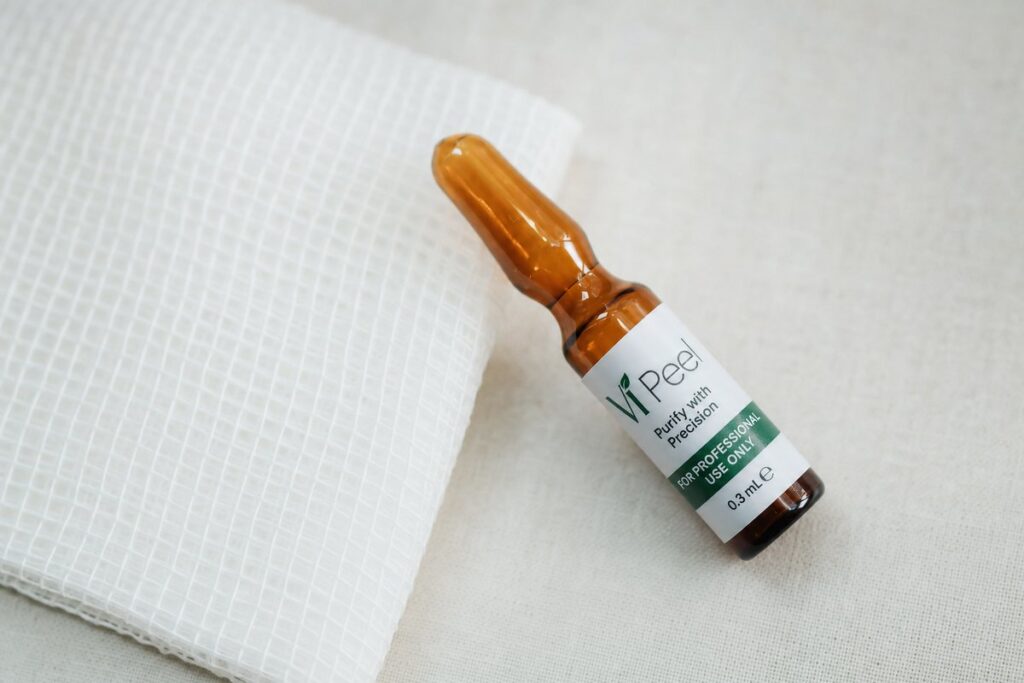
At Miami Lakes Med Spa, we mostly use the VI Peel and VI Peel Precision Plus. These are medical-grade blends that are well-studied and safe for a wide range of skin tones when applied by a trained provider.
Who Should Not Get a Chemical Peel
Some conditions are absolute peel contraindications — meaning we won’t treat you until things change. Others are relative, and we may just adjust the plan.
Absolute contraindications:
- Pregnancy or breastfeeding — most peel acids haven’t been tested as safe
- Isotretinoin (Accutane) use in the last 6 months — skin heals poorly
- Active cold sore or herpes outbreak on the treatment area
- Open cuts, active acne cysts, or infected skin
- Recent facial surgery or laser (within 3 months)
- Known allergy to any peel ingredient
- Sunburn or heavy tan on the day of treatment
Relative contraindications — proceed with caution:
- Fitzpatrick skin types IV–VI (higher risk of post-inflammatory hyperpigmentation)
- History of keloid or hypertrophic scarring
- Active eczema, rosacea flare, or psoriasis on the face
- Recent use of retinoids, hydroquinone, or exfoliating acids (stop 5–7 days before)
- Autoimmune conditions or immunosuppressive medications
- History of cold sores (we prescribe antiviral before treatment)
Radiation therapy to the face in the past year is also a stop sign. If you have any of these, tell your provider — we’ll build a safer plan or suggest an alternative.
Chemical Peel Safety: Common Side Effects vs. Warning Signs
Knowing what’s normal makes a huge difference in how calm you feel during recovery.
Normal side effects (days 1–7):
- Redness that fades over 24–72 hours
- Tightness and mild stinging
- Flaking or peeling starting day 3
- Slight darkening before the peel sheds
- Mild swelling for the first day
Warning signs — call us right away:
- Fever, chills, or feeling unwell
- Spreading redness or hot skin beyond the treated area
- Pus, yellow crusting, or a bad smell
- Blisters bigger than expected or open wounds
- Severe pain that gets worse instead of better after day 2
- New cold sore or fever blister
These can point to infection, allergic reaction, or delayed healing. Early care almost always fixes the problem — waiting rarely does.
Your Pre-Treatment Checklist
Here’s the checklist Dr. Sabrina Gonzalez walks patients through before their peel:
Two weeks before:
- Stop using retinoids, retinol, or Accutane
- Avoid waxing, threading, or hair removal creams on the area
- Stay out of direct sun; wear SPF 30+ daily
- Skip other resurfacing (laser, microneedling, dermabrasion)
One week before:
- Stop AHAs, BHAs, and exfoliating scrubs
- Start antiviral medication if you have a cold sore history (we’ll prescribe)
- Hydrate — drink water daily
Day of treatment:
- Come with clean skin, no makeup
- Bring a hat and sunglasses for the ride home
- Have gentle cleanser and bland moisturizer ready at home
- Clear your calendar for 3–5 days of peeling
Our Safety Standards at Miami Lakes Med Spa
Chemical peel safety starts with who’s holding the applicator. Every peel at Miami Lakes Med Spa is performed by a licensed medical provider — not a facialist or unlicensed tech. Our lead injector, Dr. Sabrina Gonzalez, DNP, APRN, has 5+ years in medical aesthetics and specializes in natural, balanced results.
Medical Director Dr. John Serpa, MD, provides physician oversight on every protocol. That MD + NP model means you get real medical decision-making, not just a menu of services.
We follow FDA labeling for every product, use only medical-grade formulations, and screen every patient with a full intake form and in-person assessment. If you’re not a good candidate, we’ll tell you — and often suggest a safer option like SkinPen microneedling instead.
Aftercare That Protects Your Results
Aftercare is where a lot of home-peel disasters happen. Here’s what we tell every patient:
- Do not pick or peel the flaking skin — you’ll cause scars or dark spots
- Wash with a gentle, non-foaming cleanser twice a day
- Apply a bland, fragrance-free moisturizer often
- Use mineral SPF 30+ every morning, reapply every 2 hours outside
- Skip makeup for 24–48 hours if possible
- No workouts, saunas, or hot showers for 48 hours
- No retinoids, acids, or scrubs for 2 weeks after
Follow this and your peel does its job. Skip it and you risk uneven results or pigment problems — especially in South Florida sun.
Chemical peel safety comes down to two things: honest screening and a skilled provider. If you have any of the contraindications listed above, don’t hide them — share them so we can build a plan that actually works for your skin. And if you’re a good candidate, a well-done peel can be one of the most rewarding skin treatments you’ll ever try.
Ready to find out if a peel is right for you? Book a free consultation with Dr. Sabrina Gonzalez, DNP, APRN at Miami Lakes Med Spa. We serve Miami Lakes, Hialeah, Miami Gardens, Miramar, Pembroke Pines, and Doral. Call 305-418-0392 or book online today.
Last reviewed 2026. This content is for informational purposes and is not a substitute for professional medical advice. Individual results may vary — always consult with a qualified provider before starting any treatment.
Frequently Asked Questions
Can I get a chemical peel while pregnant?
No. Pregnancy is an absolute contraindication for most chemical peels. The acids used — including salicylic and TCA — haven’t been proven safe for pregnancy or breastfeeding. We recommend waiting until after you’ve finished nursing. In the meantime, a gentle facial or hydrating treatment is a safer choice.
How long after Accutane can I get a peel?
Wait at least 6 months after your last Accutane (isotretinoin) dose. The drug thins your skin and slows healing, which raises your risk of scarring and prolonged redness. Once you’re past the 6-month mark and cleared by your dermatologist, a superficial peel is usually safe to schedule.
Are chemical peels safe for darker skin tones?
Yes — with the right peel. Fitzpatrick types IV–VI have a higher risk of post-inflammatory hyperpigmentation, so acid choice matters. At Miami Lakes Med Spa, we often use VI Peel Precision Plus for melanin-rich skin because it’s well-studied and evenly formulated. A pre-treatment consultation with Dr. Sabrina Gonzalez is essential.
What should I do if my skin blisters after a peel?
Call us at 305-418-0392 right away. Small pinpoint flakes are normal, but true blisters or open sores are not. Do not pick, pop, or apply home remedies. Keep the area clean, cover with a bland ointment, and come in so we can assess for infection or an unusual reaction.
References